
A workflow is a structured system of steps that defines what is done, when, who performs it, and how each action is prioritized. In the context of performance marketing, an efficient workflow determines how a team reviews campaigns, identifies issues, makes decisions, and measures results. Without this structure, teams operate reactively: putting out fires instead of building consistent results. Designing robust workflows is the difference between an agency that scales and one that’s always working at its limit.
What is a workflow, and what is its purpose in digital marketing?
A digital marketing workflow is a structured sequence of tasks and decisions that guides the team from initial monitoring through to the implementation of improvements. It’s not about adding bureaucracy to the process. It’s about eliminating the chaos that results from working without a defined approach.
Workflows are used to:
- Standardize the process by which the team reviews and optimizes campaigns on Meta Ads, Google Ads, TikTok Ads, and other platforms.
- Cut down on the time you waste deciding what to do first thing every morning.
- Ensure that no customer is left without a service check due to a lack of infrastructure.
- Facilitate the onboarding of new team members without compromising quality.
- Create a change log that allows us to learn from each optimization.
This type of system benefits agency directors who manage multiple clients, performance managers who coordinate teams, and freelancers who need to operate with the efficiency of a large team without actually being one.
The problem with working without a workflow
Most high-performing teams don't have a talent problem. They have a systemic problem. When there is no defined workflow, the work depends on the mood of the day, the latest alert that came in, or the client who shouted the loudest.
Signs that your team isn't working smoothly
- Campaign reviews take place when something goes wrong, not proactively.
- Each team member reviews different metrics using different criteria.
- There is no record of what changes were made or why.
- Client reports are created manually from scratch each time.
- Team meetings begin with the question: “What are we doing today?”
Operational consequences of a lack of structure
Working without a workflow has measurable consequences for campaign performance and team morale:
| Affected area | Consequence without flow | Result with defined flow |
|---|---|---|
| Campaign Review | Irregular, reactive, incomplete | Systematic, proactive, and prioritized |
| Decision-making | Based on urgency or intuition | Based on predefined data and criteria |
| Optimizations | Multiple simultaneous changes without logging | Controlled changes with monitoring |
| Customer reports | Repetitive manual labor every week | Automated and consistent reports |
| Talent Acquisition | A long and costly learning curve | Onboarding guided by clear processes |
What defines an efficient workflow in terms of performance
An efficient workflow isn't longer or more complex. It's clearer. It clearly defines exactly what happens at each stage of the work cycle and who is responsible for each step.
The four pillars of a solid workflow
Every effective performance marketing workflow must answer four key questions:
- What should you track? Define the metrics and signals that matter for each account or campaign. Not everything is equally important.
- When should it be reviewed? Set review frequencies: daily for spending and performance metrics, weekly for trend analysis, and monthly for strategic reviews.
- How are priorities set? When there are multiple alerts or detours, the workflow specifies which one to address first and based on what criteria.
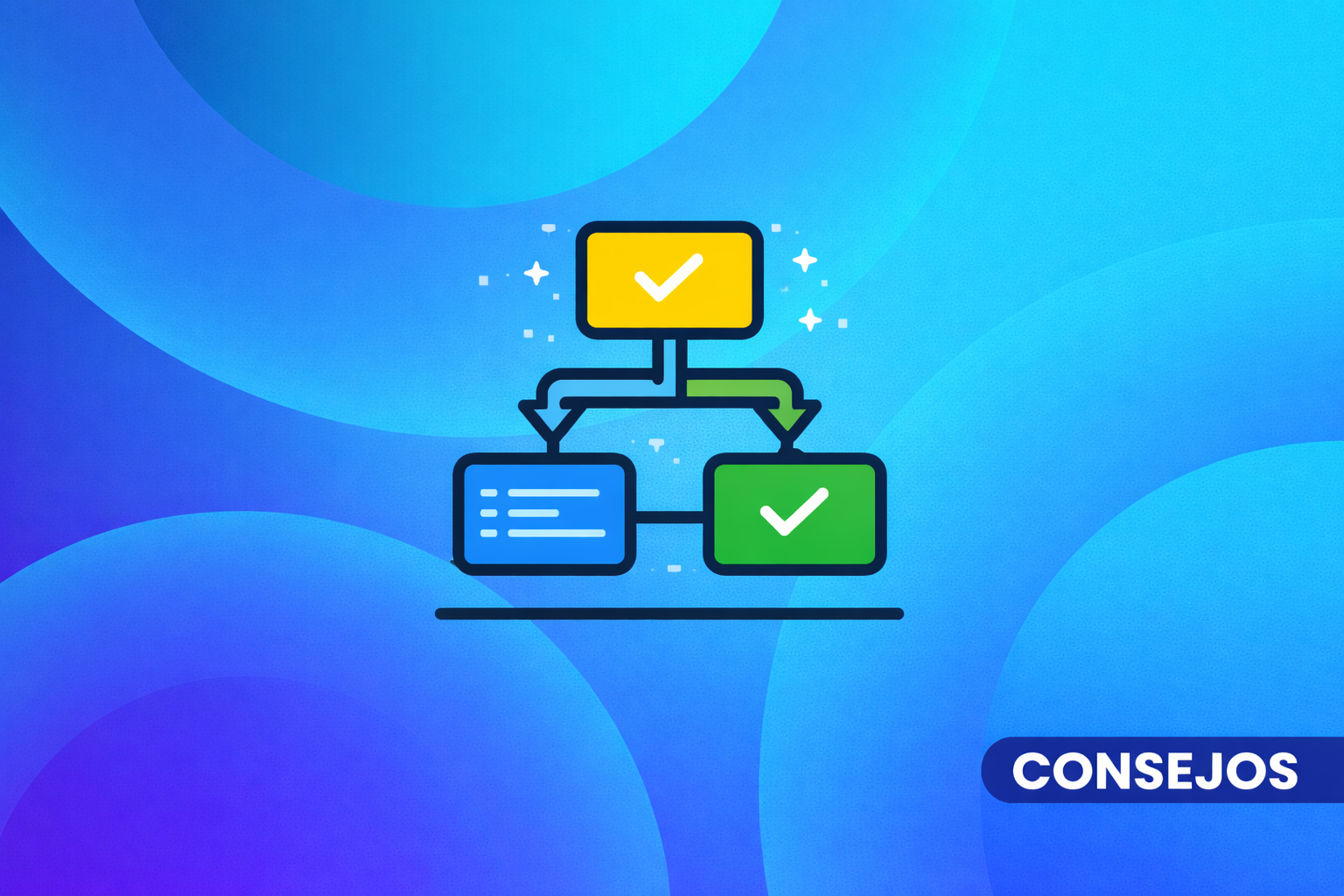
- What actions are taken? Define a basic decision tree: if X occurs, evaluate Y and execute Z.
The stages of the performance work cycle
A well-designed workflow for performance teams includes the following steps in this order:
- Daily monitoring of key metrics: CPC, CTR, ROAS, CPA, and cumulative spend versus budget.
- Deviation detection: Identifying areas that deviate from benchmarks or goals agreed upon with the client.
- Contextual analysis: Determine whether the deviation is due to an external factor, a seasonal factor, or a campaign issue.
- Definition of a hypothesis: Formulating a probable cause before altering any variables.
- Implementing changes: Make one change at a time and document it, including the date and objective.
- Monitoring results: Assess the impact of the change in the next period before making another adjustment.
Order matters. Skipping steps—especially analysis and hypothesis-building—leads to inconsistent decisions that hinder the team’s learning.
Common mistakes in day-to-day management without a defined workflow
Review everything without prioritizing anything
When there are no clear priorities, the team spends time reviewing campaigns that are performing well and overlooks those that need the most attention. The workflow determines what requires urgent review and what can wait.
Optimize without prior diagnosis
Changing bids, creative assets, or audiences without first understanding why performance has dropped is one of the most common causes of instability in campaigns. A workflow forces the team to diagnose the issue before taking action.
Modify multiple variables at the same time
If you change the bid, the budget, and the targeting all on the same day, it’s impossible to know which change led to the next result. A systematic approach enforces discipline: one change at a time, with proper documentation and a period of observation.
Failing to document the changes made
Without documentation, the team doesn't learn. The same mistakes are repeated with different clients. Documenting within the workflow turns every campaign into a knowledge asset for the agency.
How to Design a Workflow Step by Step
- Map out the current workflow: Before you start designing, document how the team works today. Identify any inconsistencies or steps that are frequently skipped.
- Define benchmark metrics by client: Establish the KPIs to be monitored for each account and the thresholds that trigger an alert or intervention.
- Set review intervals: Daily, weekly, and monthly are the three basic cycles. Each addresses different questions and requires different actions.
- Create a basic decision tree: Define what to do when a metric falls below the threshold. The team shouldn't have to start from scratch every time a known issue arises.
- Centralize data in one place: A workflow runs more smoothly when the team doesn’t have to switch between platforms to get context. Tools like Master Metrics integrate data from Meta Ads, Google Ads, GA4, and other sources into a unified dashboard, significantly reducing the time spent on daily reviews.
- Document each change with the date and objective: Create a log of optimizations for each client. It can be as simple as a shared spreadsheet or a module within your reporting tool.
- Review and adjust your workflow every quarter: Workflows aren't static. What works today may become obsolete if your team grows, your customers change, or platforms update their algorithms.
Manual workflows vs. automated workflows
| Criterion | Manual flow | Partially automated workflow | Fully automated workflow |
|---|---|---|---|
| Daily review time | Note: Each metric is reviewed separately on each platform | Some data is centralized, while other data is not | Bottom: unified dashboard with all sources |
| Process consistency | It depends on each member of the team | Partially standardized | The same process for the entire team |
| Report Generation | Manual, between 2 and 6 hours per customer | Semi-automatic, requires manual adjustment | Automatic, updated in real time |
| Scalability | Challenging: more customers means a proportionally greater workload | Average: improves over time | Scaling: The team can grow without increasing the operational workload |
| Representative tools | Spreadsheets, direct access to each platform | Looker Studio, Databox | Master Metrics, Whatagraph, AgencyAnalytics |
Automation doesn't replace the team's judgment. It frees up time so that judgment can be applied where it really matters: in analysis and decision-making, not in data collection.
Frequently Asked Questions About Digital Marketing Workflows
How long does it take to implement a workflow at an agency?
The time required varies depending on the size of the team and the number of active clients. A small agency can have a basic workflow in place within two or three weeks. The important thing isn’t that it’s perfect from the start, but that it’s consistent. A simple workflow that’s consistently followed is always better than a complex one that’s only used when there’s time.
Does a workflow limit the team's creativity or flexibility?
No. A workflow defines the operational process, not strategic decisions. The team still has the freedom to propose hypotheses, test new ideas, or change approaches. What the workflow eliminates is the uncertainty about what to do first or how to prioritize—not the ability to innovate.
What metrics should be included in the daily review within the workflow?
Daily review metrics should be those that can change significantly within 24 hours and whose deviations have an immediate impact: cumulative spend versus budget, CPA or ROAS versus target, and frequency in reach campaigns. Trend metrics such as engagement or conversion rate can be reviewed on a weekly basis.
How can we document changes without it becoming an administrative burden?
The log doesn't need to be lengthy. One line per change is sufficient: the date, the campaign affected, what was changed, and why. This information can be kept in a shared spreadsheet or within the management tool your team uses. The goal is for anyone to be able to understand in 30 seconds what was done and why.
Do workflows work the same way for large agencies and freelancers?
Yes, although the level of complexity varies. A freelancer managing five clients needs a workflow that allows them to handle all their accounts in the shortest possible time. An agency with a team also needs the workflow to be transferable: any team member should be able to follow it without relying on the person who designed it. In both cases, the logic is the same: clarity on what to do, when, and how.
How often should I review and update the workflow?
A quarterly review is sufficient for most teams. However, there are times when an earlier review is warranted: when a client with unusually high volume or complexity is brought on board, when a platform changes its data structure, or when the team grows and current processes create bottlenecks. The workflow should adapt to the reality of the business, not the other way around.
How does Master Metrics help maintain an efficient workflow?
Master Metrics consolidates data from Meta Ads, Google Ads, LinkedIn Ads, TikTok Ads, GA4, and other sources into a single dashboard. This eliminates one of the biggest obstacles to maintaining a consistent workflow: the fragmentation of data across platforms. When the team has all the data in one place and reports are generated automatically, the time previously spent collecting information can be invested in analysis and decision-making. Agencies that implement this type of centralization report savings of up to 50% in operational reporting time.
Conclusion
Designing an efficient workflow is not a minor administrative task. It is the foundation upon which the sustained performance of any performance marketing team is built. Without a clear system, even the best professionals end up operating below their true potential—not because of a lack of talent, but because of a lack of structure.
A well-designed workflow reduces the time spent on daily reviews, improves the quality of decisions, facilitates team growth, and turns every campaign into a learning opportunity. The results aren’t immediate, but they are cumulative: every week the team operates with clear guidelines is a week in which fewer errors are made, more opportunities are identified, and greater value is delivered to the customer.
If the first step toward that system is to centralize data from all platforms in one place, Master Metrics is designed to do just that. It automates reporting, eliminates repetitive manual work, and gives your team back the time they should be spending on what really matters: thinking, deciding, and improving.